
Criminal Cases in the Brunswick County Courts
Brunswick County criminal cases are part of North Carolina's state court system. Superior Court hears felony trials. District Court handles misdemeanors, infractions, probable-cause proceedings, and early felony matters. Brunswick County is in Prosecutorial District 15, District Court District 15, and Superior Court District 15B. The Clerk of Superior Court maintains files for both trial divisions at the same Bolivia courthouse. City ordinance and misdemeanor charges from Leland, Oak Island, and other towns also enter District Court. North Carolina does not give those municipalities separate criminal courts.
A case file begins with the charge accepted for court, not merely the allegation typed at jail intake. Prosecutors may amend, replace, or decline a charge. The clerk then records hearings, pleas, motions, judgments, costs, and sentences. That makes the Brunswick County court record the best source for the filed charge and its outcome. An arrest report remains useful, but it answers a different question about the officer's action and initial facts.
Brunswick County Criminal Court Divisions
One courthouse does not mean one docket. District Court can resolve a misdemeanor or infraction, while a felony may begin there for its preliminary steps and later move to Superior Court. A reader should check the case location, type, and status before assuming which judge or division owns the next event. The District Attorney for District 15 prosecutes the case, but the prosecutor's office is not a substitute for the clerk when the request is for the complete public case file.
The Brunswick court contact directory separates the criminal desk, judges, district attorney, and other court contacts. Call the criminal desk at 910-253-3902 for a file question. The main clerk line is 910-253-3900. The criminal court page image on the official Brunswick court hub also shows where calendars and online services connect.
The hub places county calendars, contact details, and statewide digital tools in one official route, while the clerk remains the local file custodian.
How to Search Case Records
The North Carolina eCourts Portal gives free, near-real-time case information through Smart Search. It is useful for locating an active or completed Brunswick County case, but it is not a certified statewide criminal-history report. For a formal clerk search, certified copy, older paper record, or document not available as an image, use the courthouse terminal and criminal desk.
- Open Portal Smart Search and enter a party name or case number.
- Filter the location to Brunswick County and narrow by case type, status, or date if those controls appear.
- Open the Case Summary and Register of Actions, then check each charge line on its own.
- Compare the filing, hearing, disposition, and financial entries instead of treating the latest event as the outcome.
- Ask the Brunswick County clerk for inspection, paper copies, or certification when the online view is incomplete.
| Field or control | Type | Required | Format or use |
|---|---|---|---|
| Smart Search | Text | Yes | Party name or case number |
| Case number | Text | Alternative | YY + case type + six digits + three-digit county identifier |
| Party name | Text | Alternative | Last, first; supported wildcards require minimum characters |
| Location | Filter | Optional | Select Brunswick County or its court location |
| Case type, status, date | Filters | Optional | Narrow a broad result list |
| Search or Reset | Buttons | No | Run or clear the query |
Use the official Portal training resources when a wildcard or case number returns too many results. Search and Reset control the query, while Advanced Filtering Options can narrow location and case attributes. A result remains a finding aid until its charge details and clerk-held source record are checked.
Brunswick County Criminal Case Numbers
North Carolina's modern criminal case format joins the filing year, case type, six-digit sequence, and three-digit county identifier. An official example is 21CR000003-910. A partial case-number search needs at least four characters followed by an asterisk. For names, Portal guidance allows a wildcard after at least three last-name characters and at least one first-name character. These rules help when spelling or the full number is uncertain, yet broad name matches still require care.
Do not merge records just because two Brunswick County results share a name. Compare the case number, court location, filing date, attorneys, and charge details. Court files are organized by case, while SBI records are organized by fingerprint-supported arrest cycles and jail records by custody events. The structure explains why the same incident may appear under different labels across systems.
Note: A matching name is a lead, not proof that two Brunswick County case records concern the same person.
What the Case File Shows
A Brunswick County case summary can include far more than a result label. Review every charge and its own disposition date. The Register of Actions provides the event trail, while public document images vary. Financial entries may include court costs, fines, restitution, attorney fees, or a payable balance. Portal can accept some case payments, but it does not take cash bonds or bond forfeitures.
| Case number and court | Identifies the file, location, type, filing date, status, and judicial officer where public. |
|---|---|
| Parties and counsel | Lists the State, defendant, and public attorney information. |
| Charges | Shows description, statute or code, class, sequence, and filing or disposition dates. |
| Register of Actions | Tracks process, hearings, continuances, pleas, judgment, sentence, and financial events. |
| Hearings | May show event type, date, time, courtroom, and judicial officer. |
| Disposition and sentence | Records the charge-specific outcome, judgment, and sentence rather than one blanket case result. |
| Documents and redactions | Images may be limited; protected identifiers and restricted matters are omitted. |
These fields should be read together. A case status may describe the file as a whole, while the disposition rows resolve each count. If one document or event seems inconsistent, the clerk can provide the paper record that controls over a partial online view.
Brunswick County Court Records at Clerk
The clerk counter closes the gaps left by Portal. A self-service terminal can search by defendant name, case number, or victim or witness name. Paper files are inspected in the county where the case sits, and copies are available for a fee. The Judicial Branch directs people seeking a formal criminal record search to the clerk, not just the public Portal. Ask what type of copy is needed before paying, since a plain copy and a certified record serve different purposes.
The Brunswick County Courthouse page confirms the office at 310 Government Center Drive NE, Unit 1, Bolivia, NC 28422. Public hours are 8:30 a.m. to 5 p.m. weekdays. Its official courthouse photograph and access details help a visitor identify the correct Judicial Branch building within the government complex.
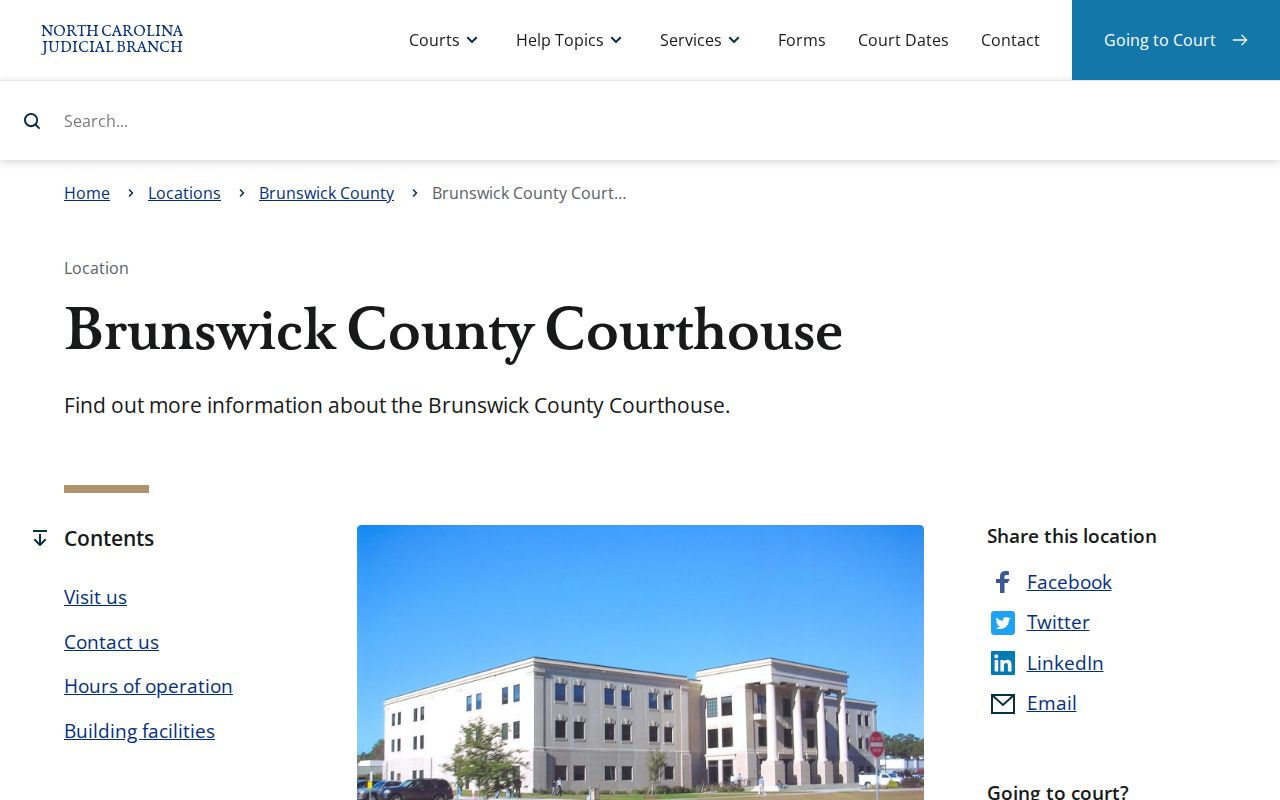
The courthouse is separate from Brunswick County government, so general county request forms should not be used for criminal case files.
Stages of a Criminal Case
A Brunswick County criminal case changes as it moves. The arresting allegation may be screened by the prosecutor. District Court can resolve a misdemeanor, while a felony may proceed through probable-cause or grand-jury steps before Superior Court arraignment and pretrial work. A plea or trial produces the disposition. Judgment and sentence follow, with appeal or other post-conviction events possible later.
Case flow: Charges Filed › Arraignment › Pretrial › Plea or Trial › Disposition › Sentencing
Portal entries mark events, not always their legal effect. A continuance moves a date and is not a disposition. A dismissal is not the same result as a not-guilty verdict. When one charge ends and another remains open, the case cannot be reduced to a single outcome word.
Read Brunswick County Case Outcomes
The best check begins with the charge table and then moves to the Register of Actions. Match each count to its filing and disposition dates. Look for a plea, judgment, or dismissal tied to that count. Hearing entries can explain the path, but a scheduled event does not prove it occurred or resolved the charge. A balance or payment entry also does not state guilt by itself.
If a document image is missing, note the case number and ask the clerk for the paper file or an available copy. Bring the number on paper because the Brunswick County courthouse prohibits cell phones. This small local rule matters when a visitor planned to show the docket from a phone. For a wider overview of how court, arrest, and state records differ, use the Brunswick County criminal history overview.
Brunswick County eCourts Since 2025
Brunswick County joined Enterprise Justice, also called Odyssey, on February 3, 2025, with twelve other coastal counties. The move changed the public route from the older case-management process to Portal Smart Search. By October 13, 2025, all one hundred North Carolina counties used the system. A statewide platform makes cross-county court searches more consistent, but it does not turn Portal into an SBI rap sheet or guarantee that every document image is online.
The Judicial Branch rollout notice dates the Brunswick County conversion. Older files, certified copies, and restricted documents still depend on the clerk. The practical rule is simple: use Portal to locate and read public case data, then use the Brunswick County criminal desk when the result must be complete, certified, or checked against paper.
Access & Restrictions
North Carolina law supports public access to court records, but access is not absolute. G.S. 7A-109 governs court records and copies. Juvenile matters, sealed or expunged cases, confidential documents, and protected identifiers may be absent or redacted. Online metadata also does not mean that every filed image can be downloaded.
When a Brunswick County criminal case does not appear, verify spelling, wildcards, location, and case number before drawing a conclusion. Then call the clerk about paper or restricted-access status. Do not ask the county's administrative records office or the District Attorney to act as the court-file custodian. If the issue began with a jail entry, use the Brunswick County arrest history channels to identify the agency and booking event before comparing the filed case.
The North Carolina Judicial Branch public-record request is another official route for qualifying court-system records. A local criminal case file still belongs with the Brunswick County clerk, so use the statewide form only when its routing fits the record sought.